Baseus 9-in-1 USB-C Dock 4K vs Baseus 12-in-1 Triple Display Laptop (2026): Key Differences
As an Amazon Associate we earn from qualifying purchases. Links on this page are affiliate links.
Comparing the baseus 9 in 1 USB c dock 4k vs 12 in 1 triple display laptop, you see two distinct expansion solutions from Baseus. Both devices connect via USB-C and provide stable gigabit Ethernet for reliable internet access. They also share similar power delivery capabilities to keep your laptop charged during heavy use. The main difference lies in their display architecture. One unit focuses on a compact dual-monitor setup with high refresh rates, while the other offers a triple-display configuration with an ergonomic stand design.
Key differences
| Aspect | Baseus 9-in-1 USB-C Dock with 4K 120Hz HDMI | Baseus 12-in-1 Triple Display Laptop Stand Dock |
|---|---|---|
| Display Support | Dual monitors | Triple displays |
| Video Ports | HDMI | 2x HDMI, DisplayPort |
| Max Resolution | 4K@120Hz | 4K |
| Data Speed | 5Gbps (USB 3.0) | 10Gbps (USB-C 3.0) |
| Design | Compact hub | Ergonomic stand with kickstand |
| USB Ports | 2x USB 3.0, 1x USB 2.0 | 2x USB-C 3.0, 3x USB-A |
Which one should you choose?
Choose Baseus 9-in-1 USB-C Dock with 4K 120Hz HDMI if
- You need a high refresh rate of 120Hz for smoother visuals on dual screens
- You prefer a compact, portable hub that fits easily into a laptop bag
- You primarily use Windows laptops for extended dual-monitor workflows
Choose Baseus 12-in-1 Triple Display Laptop Stand Dock if
- You want to connect three displays simultaneously for maximum multitasking
- You need faster data transfer speeds up to 10Gbps for large files
- You want an integrated stand to elevate your laptop for better ergonomics
Verdict: Choose the 9-in-1 dock if you prioritize portability and high refresh rates for a dual-monitor setup. Opt for the 12-in-1 stand dock if you require triple display support and faster data speeds for a stationary workspace.
Baseus Dock vs Triple Display Stand
Display support
Product A supports dual monitors with a single HDMI port capable of 4K at 120Hz. It allows extended mode on Windows, though macOS only mirrors. Product B supports triple displays using two HDMI ports and one DisplayPort. It delivers 4K clarity across all screens for multitasking. Product B offers more screen real estate with three outputs. Product A is limited to two screens. If you need three distinct workspaces, Product B is the better choice. Product A is sufficient for a standard dual-monitor setup.
Refresh rate
Product A explicitly lists a maximum resolution of 4K at 120Hz on its HDMI port. This high refresh rate benefits smooth motion for gaming or fast-paced video editing. Product B lists a maximum resolution of 4K but does not specify a refresh rate in the provided data. Without a stated 120Hz capability, you cannot assume it matches Product A’s frame rate. For smooth visuals, Product A provides a clear advantage. Product B may support high refresh rates, but the data does not confirm this. Stick with Product A if 120Hz is required.
Data speed
Product A features USB 3.0 ports with a maximum data transfer speed of 5Gbps. This is fast enough for HD movies and standard peripherals. Product B includes USB 3.0 ports with a maximum data speed of 10Gbps. This doubled bandwidth allows for even faster file transfers and supports higher-performance external drives. Product B handles large data loads more efficiently. Product A is adequate for general use, but Product B is superior for heavy data workflows.
Build and design
Product A is a compact hub measuring 5.31 inches in length and weighing 5.3 ounces. It is lightweight and portable, fitting easily into a laptop bag. Product B features an ergonomic stand design that elevates your device. It includes a screen-lock button and improves heat dissipation. It is larger and heavier due to the stand structure. Product B is better for a fixed desk setup. Product A is better for travel. Choose based on whether you need portability or a stable stand.
Connectivity options
Product A offers 9 ports, including two HDMI ports, one USB-C charging port, two USB 3.0 ports, one USB 2.0 port, and SD/TF card readers. Product B offers 12 ports, including two HDMI ports, one DisplayPort, three USB-A ports, two USB-C 3.0 ports, and SD/TF card readers. Product B provides more USB-A ports and adds a DisplayPort. Product A has a dedicated USB 2.0 port for peripherals. Product B has more total connectivity options. Product B is better for users with many wired devices.
Which Baseus Dock Fits Your Desk
You need three screens for work
This dock supports triple 4K displays using two HDMI ports and one DisplayPort. The ergonomic stand elevates your laptop for better posture and improves heat dissipation. You get a larger workspace for multitasking without needing additional monitors or complex cable management.
You want high refresh rate video
This model offers 4K resolution at 120Hz via its single HDMI port. This higher refresh rate provides smoother visuals for compatible devices. It is a compact grey hub that connects via USB-C and includes dual monitor support for Windows extended mode.
You prioritize fast data transfer speeds
This dock features USB 3.0 ports supporting up to 10Gbps data transmission. This is twice the speed of the competing 5Gbps ports. You can transfer large files and HD movies more quickly, which is essential for video editors and photographers.
You prefer a lightweight portable setup
This hub weighs only 5.3 ounces and measures 5.31 inches in length. It is significantly smaller and lighter than the stand-style dock. You can easily carry it in a laptop bag for travel or use it as a simple desktop expansion solution.
The products compared

Baseus 9-in-1 USB-C Dock with 4K 120Hz HDMI
Best for: Windows users needing dual 4K@120Hz displays
- Host Interface
- USB-C
- Display Support
- Dual
- Max Resolution
- 4K@120Hz
- Power Delivery
- 85W
- Port Count
- 9
- Video Ports
- HDMI
View on Amazon: Baseus 9-in-1 USB-C Dock with 4K 120Hz HDMI Affiliate link
This Baseus 9-in-1 dock supports dual 4K displays at 120Hz via HDMI. It includes a 1000Mbps Ethernet port and 85W power delivery for your laptop. The hub features USB 3.0 ports for 5Gbps data transfer and SD/TF card slots for photographers. It is a compact, grey unit weighing 5.3 ounces. This setup suits users needing high refresh rates and stable wired connections for their workspace.
Pros
- Supports dual monitors in extended mode on Windows
- HDMI output reaches 4K resolution at 120Hz
- 1000Mbps Ethernet port for stable network connectivity
- 85W power delivery to charge your laptop
- SD and TF card slots for fast photo transfers
Cons
- MacOS devices only support mirror mode, not extended dual displays
- Only includes two HDMI ports, limiting triple-screen setups
- Consumes 15W of power itself, reducing total delivery to 85W
Good fit if
- You use a Windows laptop and need extended dual monitors
- You require 120Hz refresh rates for smooth visuals
- You need a wired 1000Mbps Ethernet connection
Skip if
- You use a Mac and need extended dual displays
- You want to connect three monitors simultaneously
- You prefer wireless connectivity over Ethernet
Verdict: Baseus 9-in-1 USB-C Dock 4K@120Hz is a solid choice for Windows users who need high-refresh dual displays and wired networking. It delivers stable performance for productivity but lacks the multi-screen flexibility of higher-port models.
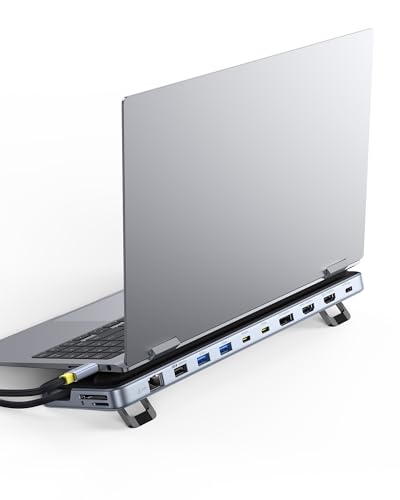
Baseus 12-in-1 Triple Display Laptop Stand Dock
Best for: users needing three 4K monitors
- Host Interface
- USB-C
- Display Support
- Triple
- Max Resolution
- 4K
- Power Delivery
- 85W
- Port Count
- 12
- Video Ports
- HDMI, DisplayPort
View on Amazon: Baseus 12-in-1 Triple Display Laptop Stand Dock Affiliate link
This Baseus dock supports three 4K displays via two HDMI ports and one DisplayPort. It includes three USB-A ports, two USB-C 3.0 ports, and Gigabit Ethernet. The unit features a stand design for heat dissipation and posture. It delivers 85W of power delivery output from a 100W input. The silver unit measures 11.2 by 3.15 inches. It suits users needing extensive connectivity and multiple screens.
Pros
- Supports triple 4K displays simultaneously
- Includes Gigabit Ethernet port
- Provides 85W PD output
- Features ergonomic stand design
Cons
- Requires a USB-C host interface
- No mention of audio output ports
- Larger footprint than single-port hubs
Good fit if
- You need to connect three monitors
- You require stable wired internet
- You want a raised laptop stand
Skip if
- You only need one external screen
- Your laptop lacks USB-C video support
- You need built-in speakers
Verdict: Baseus 12-in-1 Triple Display Dock fits professionals who need three 4K screens and wired networking in one station.
Specifications side by side
| Spec | Baseus 9-in-1 USB-C Dock with 4K 120Hz HDMI | Baseus 12-in-1 Triple Display Laptop Stand Dock |
|---|---|---|
| Host Interface | USB-C | USB-C |
| Display Support | Dual | Triple |
| Max Resolution | 4K@120Hz | 4K |
| Power Delivery | 85W | 85W |
| Port Count | 9 | 12 |
| Video Ports | HDMI | HDMI, DisplayPort |
| Max Data Speed | 5Gbps | 10Gbps |
| Ethernet Speed | 1Gbps | Gigabit Ethernet |
| Resolution | 4K UHD | 4K UHD |
| Connectivity | USB-C, HDMI | USB-C, HDMI, DisplayPort, Ethernet, USB-A |
| Refresh Rate | 120Hz | not stated |
| Features | Card Reader | Kickstand |
| Dimensions | 5.31 × 1.93 × 0.63 inches | 3.15 × 1 × 11.2 inches |
| Weight | 5.3 ounces | not stated |
| Size | 9 in 1 | not stated |
| Color | Grey | Silver |
Frequently asked questions
Which dock is better for Windows users needing high refresh rates?
The Baseus 9-in-1 USB-C Dock is the better choice for Windows users who require high refresh rates. It supports dual 4K displays at 120Hz via its single HDMI port. This setup provides stable performance for productivity tasks on Windows systems, ensuring smooth visuals for fast-moving content.
Can I connect three monitors to the Baseus 12-in-1 dock?
Yes, the Baseus 12-in-1 Triple Display Laptop Stand supports three 4K monitors simultaneously. It achieves this using two HDMI ports and one DisplayPort. This configuration is ideal for professionals who need a triple-screen workspace to manage multiple applications and windows efficiently without cluttering their desk.
Does the 9-in-1 dock work with macOS?
The 9-in-1 dock has limited functionality on macOS. While it supports extended mode on Windows, macOS only mirrors the display output. If you rely on macOS, you may find the multi-screen flexibility of the 12-in-1 model more suitable, as it offers more display options.
Which dock includes a stand for laptop elevation?
The Baseus 12-in-1 Triple Display Laptop Stand includes a built-in kickstand. This feature elevates your laptop to an ergonomic height, which improves posture and aids heat dissipation. The 9-in-1 dock does not mention a stand, making the 12-in-1 model better for desk organization and comfort.
What is the size difference between the two docks?
The 9-in-1 dock is compact, measuring 5.31 inches in length and weighing 5.3 ounces. In contrast, the 12-in-1 dock is taller at 11.2 inches but narrower. The 9-in-1 model is more portable, while the 12-in-1 dock is designed as a stationary station with a stand.
Do both docks provide wired internet connectivity?
Yes, both docks provide stable gigabit Ethernet connectivity. This ensures reliable internet access for both the Baseus 9-in-1 and the 12-in-1 models. You can connect your laptop directly to your router or network switch for a stable connection that is less prone to interference than wireless options.
Which dock supports 100W power delivery?
The Baseus 12-in-1 Triple Display Laptop Stand supports 100W power delivery. This allows you to charge your laptop while using the dock. The 9-in-1 dock does not specify its power delivery wattage in the provided data, so the 12-in-1 model is the clear choice for high-power charging needs.