WAVLINK or Tobenone? Docking Stations Compared in 2026
As an Amazon Associate we earn from qualifying purchases. Links on this page are affiliate links.
You are looking at WAVLINK vs tobenone docking station options for a triple monitor setup. Both devices support three displays at 4K resolution and offer USB-C connectivity. The main difference lies in port variety and power delivery. The WAVLINK model includes DisplayPort inputs and Ethernet, while the TobenONE focuses on a higher USB port count and 100W charging. You need to check your laptop's specific port requirements before buying.
Key differences
| Aspect | WAVLINK 12-in-1 Triple Monitor USB-C Dock | TobenONE 18-in-1 Triple Display Dock |
|---|---|---|
| Port Count | 12 ports | 18 ports |
| Video Ports | HDMI and Dual DisplayPort | Triple HDMI |
| Power Delivery | 85W output | 100W output |
| Ethernet | Gigabit Ethernet | Not listed |
| OS Support | Windows, Mac, Linux, etc. | Windows, Chrome OS only |
Which one should you choose?
Choose WAVLINK 12-in-1 Triple Monitor USB-C Dock if
- You need a wired Ethernet connection for stable internet.
- You use a Mac or Linux system and require broad compatibility.
- Your laptop requires DisplayPort inputs for your monitors.
Choose TobenONE 18-in-1 Triple Display Dock if
- You need more USB ports for peripherals like keyboards and drives.
- You want faster 100W power delivery to charge your laptop.
- You only use Windows or Chrome OS laptops.
Verdict: The WAVLINK dock is better if you need Ethernet connectivity and broad operating system support. The TobenONE dock is the stronger choice if you prioritize maximum USB ports and faster 100W charging. Both provide triple 4K display support for productivity.
WAVLINK vs Tobenone Dock Specs
Port variety
The TobenONE offers 18 total ports, including nine USB connections for peripherals like keyboards and drives. This setup reduces cable clutter significantly. The WAVLINK provides 12 ports, featuring two USB 3.0 and two USB 2.0 ports. It also includes SD and TF card slots for direct media access. If you need extensive peripheral connections, the TobenONE has more options. The WAVLINK focuses on essential connectivity with a balanced mix of USB and storage slots. You should choose based on how many devices you plan to connect simultaneously.
Power delivery
The TobenONE supports 100W Power Delivery to charge your laptop while using the dock. This ensures stable operation for power-hungry devices. The WAVLINK offers 85W Power Delivery output. It accepts 100W input but delivers less power to the host. Both docks require a separate certified charger for proper functionality. If your laptop requires high wattage for optimal performance, the TobenONE is the stronger choice. The WAVLINK is sufficient for many ultrabooks but may limit charging speed for larger laptops under heavy load.
Video outputs
The TobenONE uses three HDMI ports for its triple display setup. This is standard for many modern monitors. The WAVLINK uses one HDMI and two DisplayPort inputs. DisplayPort 1.4 support allows for high-resolution extensions. Both docks support triple displays at 1080p@60Hz. The WAVLINK can also drive a single 4K@60Hz display. The TobenONE supports triple 4K@60Hz displays. If your monitors use HDMI, the TobenONE is easier to connect. If they use DisplayPort, the WAVLINK is the better fit.
Connectivity options
The WAVLINK includes a Gigabit Ethernet port for stable wired internet connections. This is useful for large file transfers or low-latency work. The TobenONE also includes an RJ45 Ethernet port. Both provide reliable network connectivity. The WAVLINK adds audio and microphone combo jacks. The TobenONE includes a 3.5mm audio jack. Both docks handle basic audio needs. The presence of Ethernet in both models ensures you can maintain a stable connection without relying on Wi-Fi.
Compatibility
The WAVLINK supports Windows, Mac OS, Chrome OS, Linux, and Android with OTG. It works with Thunderbolt 3/4 laptops. Mac users can extend displays, though all three must show the same image. The TobenONE is designed specifically for Windows and Chrome OS laptops. It is not recommended for Mac users. If you use a Mac, the WAVLINK is the only viable option. For Windows users, both docks function well. You must ensure your laptop USB-C port supports video output for either model.
Choose the Right Dock for You
Windows users needing Ethernet
The WAVLINK dock includes a Gigabit Ethernet port, which the TobenONE lacks. It supports Windows, Mac, and Linux systems with driver-free setup. You get dual DisplayPort and HDMI outputs for triple displays. The 85W PD output keeps your laptop powered while you work across multiple screens.
Mac users needing triple displays
The TobenONE is not recommended for Mac users. The WAVLINK dock supports Mac OS and can drive three displays, though they will show the same image. It offers extensive compatibility with iPad OS and Chrome OS. You can connect multiple monitors for presentations or stock analysis using its USB-C interface.
Windows users wanting more USB ports
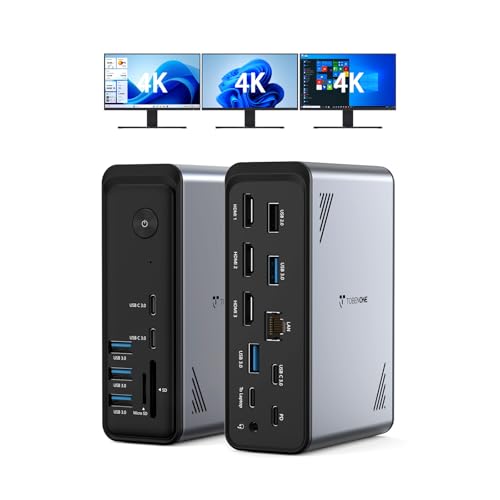
The TobenONE provides 18 ports, including nine USB connections. This is ideal for connecting many peripherals like keyboards, mice, and drives. It supports triple 4K@60Hz displays on Windows and Chrome OS laptops. The 100W PD charging keeps your device powered throughout the day without needing extra adapters.
The products compared

WAVLINK 12-in-1 Triple Monitor USB-C Dock
Best for: Windows users needing triple 1080p displays and Ethernet
- Host Interface
- USB-C
- Display Support
- Triple
- Max Resolution
- 4K@60Hz
- Power Delivery
- 85W
- Port Count
- 12
- Video Ports
- HDMI, DisplayPort
View on Amazon: WAVLINK 12-in-1 Triple Monitor USB-C Dock Affiliate link
This WAVLINK docking station supports triple displays via one HDMI and two DisplayPort outputs. It delivers 4K@60Hz on a single screen or 1080p@60Hz across three monitors. The unit provides 85W Power Delivery to keep your laptop charged while you work. It includes Gigabit Ethernet, SD/TF card slots, and multiple USB ports. You can connect peripherals through a single USB-C or Thunderbolt 3/4 host port.
Pros
- Supports triple 1080p displays or single 4K@60Hz output
- Includes dual DisplayPort and one HDMI video ports
- Provides 85W Power Delivery for laptop charging
- Features Gigabit Ethernet and SD/TF card slots
- Driver-free operation on Windows, Mac, and Linux
Cons
- 85W output is lower than the 90W+ found in some competitors
- Mac OS users can only mirror displays across all three screens
- Charger and charging cable are not included in the box
Good fit if
- You need to drive three monitors from a single laptop port
- You require Gigabit Ethernet and SD card access on your desk
- You use a Windows or Linux laptop with USB-C video support
Skip if
- You need to run three separate 4K displays simultaneously
- You want to use Mac OS with extended desktop mode on all screens
- You prefer a dock that includes the power adapter in the package
Verdict: WAVLINK 12-in-1 Triple Monitor USB-C Dock offers reliable triple display expansion with 85W charging for users who need extensive connectivity. It is a solid option for Windows and Linux users who prioritize video output and peripheral ports over maximum charging wattage.
TobenONE 18-in-1 Triple Display Dock
Best for: Windows users needing triple 4K display support
- Host Interface
- USB-C
- Display Support
- Triple
- Max Resolution
- 4K@60Hz
- Power Delivery
- 100W
- Port Count
- 18
- Video Ports
- HDMI
View on Amazon: TobenONE 18-in-1 Triple Display Dock Affiliate link
The TobenONE 18-in-1 docking station expands your laptop into a triple-monitor setup via USB-C. It supports three 4K displays at 60Hz and includes nine USB ports for peripherals. The unit provides 100W power delivery to keep your device charged. It measures 4.9 inches long and weighs 10.9 ounces. This hub is designed for Windows and Chrome OS laptops, offering a clean desk solution for productivity tasks.
Pros
- Supports triple 4K@60Hz displays via HDMI
- 18 total ports including 9 USB and card readers
- 100W Power Delivery for laptop charging
- Compact build at 10.9 ounces
Cons
- Not compatible with Mac users
- Power adapter is not included
- Requires a power supply over 65W for stable use
Good fit if
- You need three external monitors for your workflow
- You use a Windows or Chrome OS laptop
- You want to reduce cable clutter on your desk
Skip if
- You own a Mac laptop
- You need a docking station with a built-in power supply
- You require Thunderbolt connectivity instead of USB-C
Verdict: The TobenONE 18-in-1 Triple 4K Docking Station fits users who need a high-port-count hub for Windows or Chrome OS systems to drive three 4K screens. It is a solid choice for office setups where power delivery and video expansion are priorities.
Specifications side by side
| Spec | WAVLINK 12-in-1 Triple Monitor USB-C Dock | TobenONE 18-in-1 Triple Display Dock |
|---|---|---|
| Host Interface | USB-C | USB-C |
| Display Support | Triple | Triple |
| Max Resolution | 4K@60Hz | 4K@60Hz |
| Power Delivery | 85W | 100W |
| Port Count | 12 | 18 |
| Video Ports | HDMI, DisplayPort | HDMI |
| Ethernet Speed | Gigabit | not stated |
| Resolution | 4K UHD | 4K UHD |
| Connectivity | USB-C, HDMI, DisplayPort, Ethernet, USB-A | USB-C, HDMI, Ethernet |
| Refresh Rate | 60Hz | not stated |
| Use | not stated | Office |
| Slot Count | 1 Slot | not stated |
| Dimensions | 6.22 × 1.61 × 0.63 inches | 4.9 × 3.5 × 1.6 inches |
| Weight | 5.82 ounces | 10.9 ounces |
| Size | 100W | Without power supply |
| Color | Silver | Grey-docking station for Windows |
| Model | KR-RZUS-UMD303 | not stated |
Frequently asked questions
Does the WAVLINK dock support Mac and Linux?
Yes, it supports Windows, Mac, and Linux systems with a driver-free setup. This makes it versatile for users on different operating systems. You get dual DisplayPort and HDMI outputs for triple displays. The device is designed for broad compatibility without requiring additional software installation on your computer.
Which dock has more USB ports for peripherals?
The TobenONE offers 18 total ports, including nine USB connections for keyboards and drives. This setup reduces cable clutter significantly compared to other options. The WAVLINK provides 12 ports, featuring two USB 3.0 and two USB 2.0 ports. If you need maximum connectivity for many devices, the TobenONE has the higher count.
Can I use these docks for triple 4K monitors?
Yes, both devices support three displays at 4K resolution. The TobenONE is explicitly marketed for triple 4K display support. The WAVLINK model also handles triple monitor expansion. You can drive multiple high-resolution screens simultaneously. This capability is essential for users who need extensive visual workspace on their desktop setups.
Does the WAVLINK include an Ethernet port?
Yes, the WAVLINK dock includes a Gigabit Ethernet port. The TobenONE lacks this specific feature. This wired connection option is useful for stable internet access without Wi-Fi. You get reliable network connectivity alongside your video outputs. This makes the WAVLINK a stronger choice for users who prioritize wired networking in their office setup.
What is the charging wattage for the WAVLINK dock?
The WAVLINK dock provides 85W of power delivery. This charging wattage is sufficient for many laptops. It supports users who need extensive connectivity and moderate charging power. The device is a solid option for Windows and Linux users who prioritize video output and peripheral ports over maximum charging wattage.
Which dock is better for Windows office setups?
The TobenONE fits users who need a high-port-count hub for Windows or Chrome OS systems. It is a solid choice for office setups where power delivery and video expansion are priorities. The WAVLINK is also good for Windows users needing Ethernet. Both support Windows, but the TobenONE offers more peripheral ports for office gear.
How heavy are these docking stations?
The WAVLINK weighs 5.82 ounces. The TobenONE is heavier at 10.9 ounces. These weights reflect the internal components and build materials. The size dimensions also differ between the two models. You can choose based on your preference for portability versus port density in your desktop arrangement.